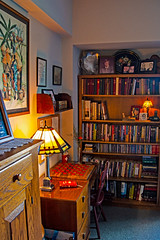
Ozzy Osbourne’s personal possessions fetch $800,000 for charity
Sunday, December 2, 2007
American heavy metal performer Ozzy Osbourne, who became famous as the lead vocalist for Black Sabbath and later as a solo act, has raised more than US$800,000 for The Sharon Osbourne Colon Cancer Program, founded by his spouse Sharon Osbourne at the Cedars Sinai Hospital, by auctioning off personal items.
A number of the items that he auctioned off over the two day period have been seen on his reality TV show The Osbournes, which featured home life with Sharon, Ozzy and their two children. Amongst some of the higher-priced items were a carved walnut Victorian-style custom built pool table which raised $11,250, a painting from Edourad Drouot which fetched $10,500, a pair of Ozzy’s famous round glasses which raised $5,250 and a dog bed given to Sharon by Elton John which sold for $2,375.
Some more famous items were also amongst the 500 lots offered. Ozzy’s black satin coat, complete with bat-wing cape, raised $3,300 and a hand-painted floral cup used regularly on The Osbournes made $1,625. A bronze plaque of a demon’s head that was regularly seen in its position adorning the front door of their house had been expected to go for $800 to $1,200instead raised $8,750. A wire model of the Eiffel Tower from on the kitchen table sold for $10,000, while skull-covered trainers Ozzy had worn reached $2,625. Bidders came from as far away as Germany to buy what they could from his mansion in Beverly Hills, California.
However, three cars included in the auction failed to attract bidders and did not sell. They were a 2006 Bentley Continental Flying Spur, estimated at $160,000 to $180,000, a 2005 Cadillac CTS-V sedan estimated at $30,000 to $40,000 and a 1950 Oldsmobile Futuramic 88 Club Coupe previously owned by author Danielle Steel estimated at $40,000 to $50,000. Sharon had earlier said of the cars “We’re not great car people. They really don’t do a lot for us.
Darren Julien, president of Julien’s Auctions, which organised the two-day sale, said “It did very well. It raised some good money for a very worthy cause.”
“For a celebrity garage sale, it was pretty spectacular.,” he went on. He also commented on the fact that there was fierce competition for the many artworks included. “We had Ozzy fans bidding against these sophisticated fine art buyers, which you don’t see every day. For the most part the metalheads were outbidding the art crowd.”